The Ultimate Setup Guide for Your 5 Series S535 2020 Qled
The 5 Series S535 2020 Qled occupies the mid-range segment of the QLED television family, offering buyers an attractive balance of color performance, smart functionality, and everyday usability without the premium price tag of flagship models. This guide helps new owners and prospective buyers understand what to expect from the S535, how to set it up for different use cases, and which adjustments and accessories deliver the best real-world experience. The advice is practical and vendor-neutral, focusing on how to extract the most value from the S535 in living rooms, home theaters, and gaming setups.
Introduction: who the S535 is for
The S535 is aimed at consumers who want the visual benefits of quantum-dot-enhanced color (QLED) but who are shopping on a budget-conscious mid-range specification. Typical buyers include families who stream television and films, gamers who want low-latency performance without top-tier costs, and apartment dwellers looking for a stylish screen that fits medium-sized rooms. The S535 tends to appeal to people prioritizing reliable smart TV amenities, bright and saturated color for daytime viewing, and a straightforward setup process.
Product overview and first impressions
Out of the box, the S535 presents a contemporary aesthetic with thin bezels and a simple stand option for tabletop placement. The build quality matches expectations for a mid-range QLED: plastics are used for cost control, but the fit-and-finish is tidy and stable. The set typically ships with a compact remote that supports basic voice commands and quick access to major streaming apps via dedicated buttons.
As a QLED model, the S535 emphasizes color volume and brightness. Quantum-dot layers help produce vibrant hues at a range of brightness levels, which is particularly useful in brightly lit rooms or for HDR content that benefits from punchier highlights. The panel usually operates at a standard 60Hz refresh rate, which is sufficient for most TV programming and many games, and it includes an adaptive game mode that lowers input lag when a console or PC is detected.
Detailed analysis: picture quality
Picture quality is the primary reason buyers choose QLED over standard LED. The S535 delivers strong color saturation and good overall contrast for a mid-range panel. Key observations for daily use:
- Color and brightness: Quantum-dot enhancement increases color volume, meaning saturated colors remain vivid even at higher brightness levels. This benefits daytime viewing and HDR highlights.
- Contrast and black levels: Expect respectable but not class-leading black performance. Mid-range panels typically use edge-lit or simple full-array backlights rather than advanced local-dimming zones, so deep blacks in dim scenes may not be as inky as premium models.
- HDR: The S535 supports standard HDR formats commonly used by streaming services. HDR performance is noticeable in bright highlights and richer color, though peak luminance and tone-mapping are limited by the panel and backlight design.
- Motion handling: Basic motion interpolation options and a modest refresh rate make sports and fast-paced content watchable. For cinephiles who dislike interpolation, the set allows disabling motion smoothing.
Detailed analysis: smart TV platform and usability
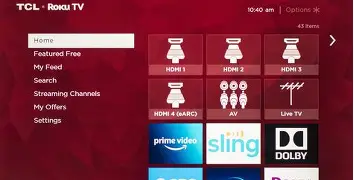
The S535’s smart platform is designed for ease of use. It offers quick access to streaming apps, a simple home dashboard, and app stores for additional services. Voice assistant integrations are often included for hands-free controls and quick searches. For everyday users, the smart interface is the hub for video-on-demand, screen mirroring, and lightweight app-based gaming.
Discover deals on TVs & Home Theater — updated daily.
Browse Now →Real-world notes:
- The home screen may offer targeted app recommendations and quick content rows — useful for households where multiple users stream different services.
- Frequent firmware updates can add features and security patches; it is advisable to enable automatic updates during initial setup.
- App load times on mid-range hardware are reasonable; launching multiple apps consecutively may be slightly slower than on premium models.
Detailed analysis: audio, inputs, and connectivity
Audio performance on mid-range TVs tends to be serviceable but limited by thin cabinet depth and small internal speakers. The S535 can reproduce dialogue clearly for most living-room viewing, but it lacks the low-frequency impact and spatial width of dedicated sound systems.
- Sound: For cinematic impact and richer bass, pairing the TV with a soundbar or compact AV receiver significantly improves the experien…
- Input lag: In game mode the TV lowers processing to reduce input lag to acceptable levels for most players. Competitive players with the highest demands may prefer displays advertised with very low input lag numbers or 120Hz panels; the S535 is targeted more toward mainstream gaming.
- Variable refresh support: Some mid-range QLEDs include VRR support to smooth frame delivery from consoles and graphics cards. Buyers should verify model specifications if VRR is a priority.
- 4K gaming: The S535 typically supports 4K resolution, which, combined with good upscaling, delivers a crisp image for modern consoles and PC outputs.
Real-world use cases
Understanding how the S535 performs in everyday environments helps potential buyers set realistic expectations:
- Family streaming hub: The S535 excels at bright-room streaming. Its vivid colors and smart platform make it ideal for shared family watching, daytime cartoons, and binge-watching series.
- Small living-room home theater: For compact home theaters with controlled lighting, the S535 offers an attractive balance of image quality and price. However, pairing with a dedicated audio solution is recommended for immersive movie sound.
- Console gaming station: Casual and mid-level gamers will appreciate large 4K visuals and decent input lag in game mode. Gamers who demand 120Hz or ultra-low latency should cross-check exact specs.
- Sports and live events: High brightness and punchy color help sports look energetic, but fast camera pans can reveal the limits of motion processing; depending on preference, motion smoothing can be adjusted.
Pros & Cons
- Pros:
- Vivid color reproduction thanks to quantum-dot enhancement
- Good brightness for daytime and HDR highlights
- Accessible smart TV platform with major streaming apps
- Competitive price point for a QLED panel
- Game mode and low-latency options suitable for most gamers
- Cons:
- Black levels and local dimming are not as deep as premium models
- Built-in speakers lack bass and spatial depth compared to sound systems
- Refresh rate generally capped at 60Hz — limited for high-frame-rate gaming
- Plastic construction may feel less premium than higher-end sets
Comparison: 5 Series S535 vs. alternatives
Below is a concise comparison highlighting how the S535 stacks up against typical alternatives in the market: a higher-tier QLED and a mainstream LED TV. Values are qualitative and intended to help buyers match priorities rather than serve as precise spec-to-spec measurements.
Looking for the best TVs & Home Theater deals on Amazon?
Shop Amazon →Feature 5 Series S535 (Mid-range QLED) Higher-tier QLED (e.g., Q70/Q80) Mainstream LED TV (Non-QLED) Color & Brightness Good – quantum-dot color, bright highlights Very Good – better color volume, higher peak luminance Average – less saturated colors, lower brightness Contrast & Black Level Moderate – limited local dimming Strong – advanced local dimming zones Variable – depends on panel (VA vs IPS) Gaming features Solid – game mode, low input lag Better – VRR, higher refresh rates on many models Basic – may lack advanced gaming features Smart Platform Comprehensive – major apps and voice assistants Comprehensive – often with faster processors Functional – app availability varies Price Mid Premium Budget Step-by-step setup guide
Setting up the S535 correctly ensures the best picture, sound, and usability. Follow these steps for a smooth installation:
1. Unbox and inspect
- Remove protective films and check for shipping damage.
- Confirm accessories: power cable, remote, stand screws, and quick-start guide.
2. Choose placement
- Place the TV at eye level for the primary seating position. For living-room sofas, the center of the screen should approximately align with seated eye height.
- Avoid placing the TV directly opposite large windows to reduce glare. If unavoidable, consider anti-glare coatings, curtains, or blinds.
- Ensure there is airflow behind the TV and the wall mount or stand can support the weight and VESA mount pattern.
3. Connect sources
- Connect consoles, streaming boxes, and Blu-ray players to the HDMI inputs. Use the HDMI ARC/eARC port for a compatible soundbar or AV receiver.
- If using wired internet, connect Ethernet. Otherwise, connect to Wi‑Fi in the network settings.
- Label inputs on the TV or in the app if multiple devices are used to make switching easier for all household members.
4. Initial software setup
- Power on the TV and follow the on-screen wizard: language, network, account sign-in for the smart platform, and channel scanning (if using an antenna).
- Allow software updates to install — updates often improve performance and app compatibility.
5. Picture calibration basics
- Choose a picture mode that fits the room: Movie/Cinema for controlled lighting, Standard for mixed use, Dynamic/Vivid for very bright rooms (note this often over-saturates color).
- Disable unnecessary post-processing for accurate motion and detail: turn off excessive sharpening and motion smoothing if it introduces artifacts.
- Adjust backlight/brightness to balance highlight detail and overall luminance. In a dark room, reduce backlight; in bright rooms, increase it for clarity.
- If available, enable the TV’s game mode when connecting a console to reduce input lag automatically.
6. Audio setup
- Test onboard speakers for dialogue clarity. If dialogue lacks presence or bass is weak, connect a soundbar or external speaker system via HDMI ARC, optical, or Bluetooth.
- Use the TV’s audio presets (e.g., Movie, Clear Voice) to tailor sound to content, but consider a soundbar for immersive use.
7. Final checks and customization
- Set parental controls and content filters if children will use the TV.
- Register the product to enable warranty and faster support.
- Create user profiles on the smart platform if the TV supports them to personalize app recommendations and watchlists.
Buying guide: what to check before purchase
When choosing an S535 or a similar mid-range QLED, keep these buyer priorities in mind:
- Screen size vs. viewing distance: Measure seating distance to choose the right screen size for comfortable 4K resolution viewing. Larger rooms typically benefit from 55"–65" screens, while smaller rooms may prefer 43"–50".
- Room brightness and window placement: For bright rooms, prioritize a TV with higher peak brightness and anti-reflective coatings. The S535’s bright highlights are advantageous in such environments.
- HDR and content sources: Confirm that the TV supports the HDR formats used by the streaming services the household relies on. HDR makes a noticeable difference if the household watches a lot of HDR-enabled content.
- Gaming needs: If gaming is a priority, check for game mode, input lag specifications, and VRR support. For next-gen gaming at high frame rates, consider models with 120Hz support.
- Sound strategy: Plan a budget for audio. Most mid-range TVs benefit greatly from adding a soundbar rather than relying on internal speakers.
- Ports and future-proofing: Ensure there are enough HDMI ports for current and future devices. An HDMI port with ARC/eARC is valuable for sound connectivity.
- Smart platform and updates: Evaluate the smart OS for app selection, ease of use, and update policies — a responsive platform improves longevity.
- Warranty and service: Investigate the manufacturer’s warranty and local service support. Extended warranties can be considered for peace of mind.
Accessories and tweaks worth considering
- Soundbar or compact speaker system: Improves dialogue clarity, bass, and cinema-like soundstage.
- Universal remote or upgraded remote: Simplifies multi-device control and can offer backlighting and programmable macros.
- Low-profile wall mount: Frees up space and creates a clean installation; ensure the mount matches the VESA pattern and supports the screen size.
- HDMI 2.1-capable cables (if needed): If using a next-gen console or PC with high-bandwidth features, select appropriate cables and verify the TV’s HDMI version support.
- Calibration tools: For enthusiasts, a basic colorimeter and calibration software can bring the panel closer to accurate reference levels.
Maintenance and longevity tips
To maximize the lifespan and maintain the performance of the S535, follow these practical tips:
- Keep firmware up to date to benefit from image processing improvements and security fixes.
- Avoid static high-contrast images for long periods to reduce the risk of retention on certain panel types.
- Use a microfiber cloth for cleaning the screen and avoid harsh chemicals; unplug the TV before cleaning.
- Maintain ventilation around the TV and avoid enclosing it in tightly packed cabinetry without airflow.
Conclusion
The 5 Series S535 2020 Qled is a compelling option for buyers seeking a mid-range QLED experience that blends vivid color, practical smart features, and straightforward usability. It performs especially well in bright-room environments and daily streaming scenarios, and it offers respectable gaming capabilities for most users. While it does not match premium models in black-level precision, local dimming sophistication, or high-frequency gaming performance, thoughtful setup and a modest audio upgrade bridge many of those gaps. With careful placement, calibration, and a few well-chosen accessories, the S535 can serve as a versatile centerpiece for family rooms, small home theaters, and casual gaming stations.